Open Science

français

Open science is the unhindered dissemination of scientific research results, methods and products.
Based heavily on the principles of open science, research reproducibility aims to enhance the transparency, robustness, reliability and reusability of scientific results.
Beyond the rigour of formal demonstrations, open science and reproducible research offer the ability to verify and reproduce computational results, reuse developed algorithms, and rely on documented and accessible data and codes.

For many years, the Jean Kuntzmann Laboratory has been fully committed to the national framework set out in the National Open Science Plan, implementing a policy of openness in publications, data and codes.

The LJK has defined guidelines in line with the policies of its supervisory bodies, in particular those of the UGA, which
adopted an open science charter and an open science master plan. in 2022.

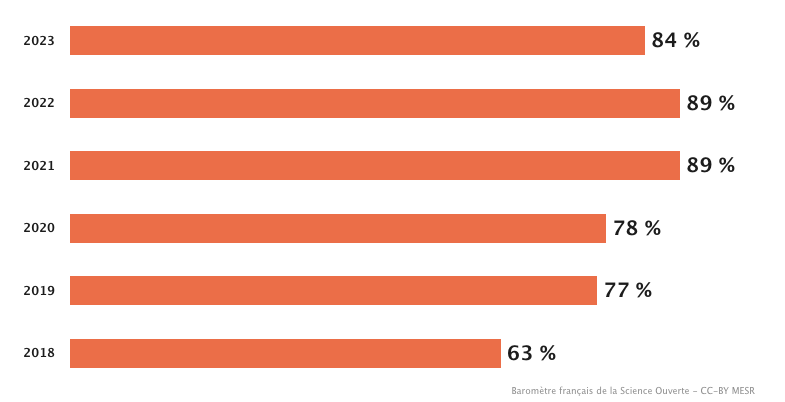
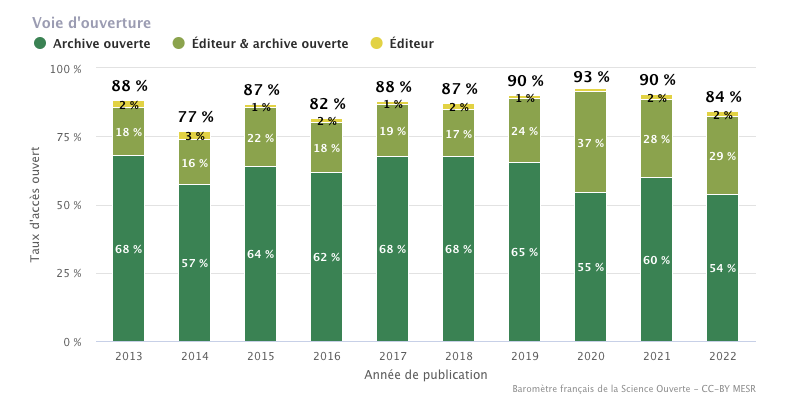
The LJK’s Open Science Barometer (BSO) shows an open access publication rate of over 94% and complete openness of theses. Below are some statistics from the BSO. The data presented is taken from publications deposited on HAL, with a DOI, between 2013 and 2024.

Awareness-raising activities, training

Through the initiatives of the SCALDE team, the laboratory offers seminars, workshops and training courses on open science, covering topics such as open science itself, reproducibility, good development practices, the use of git and gitlab, containers, publication repositories and code reporting on HAL.

All materials are available on the team website.

Doctoral training courses are also available on open science, data management, best practices for code, reproducibility, and the use of git and gitlab, among other topics:

 https://pole-calcul-formation.gricad-pages.univ-grenoble-alpes.fr/ced/
 https://scienceouverte.univ-grenoble-alpes.fr/aides-et-ressources/formation-et-seminaires/

Support

The laboratory has set up support services for open science in general, for example to assist with depositing in HAL, archiving codes on Software Heritage, distributing them as open source, and managing and depositing
data.
The SCALDE team is the primary point of contact for all laboratory members on these topics.

It is also possible to contact the support teams at the Grenoble site:
 For publications: sos-publications at univ-grenoble-alpes.fr(APC, predatory journals, etc.)
 For data: sos-data at univ-grenoble-alpes.fr
 For codes: sos-codes-recherche at univ-grenoble-alpes.fr

OSPO UGA, Open Science Committee, French Reproducible Research Network, Software Heritage

LJK members are heavily involved at local, national and European level.
 UGA Open Source Programme Office
 Open Science Committee, Source Code and Software College
 French Reproducible Research Network
 Software Heritage Ambassador Network

LJK is a partner in the European LUMEN project, which aims to develop discoverability platforms for scientific output.

Some indicators of open science at LJK

Source codes

Proportion de publications qui mentionnent l’utilisation de codes ou logiciels
Proportions de publications qui mentionnent le partage de leurs codes ou logiciels
Proportion de publications qui mentionnent la création de leurs codes ou logiciels

Theses

Taux d’ouverture des thèses de doctorat (au LJK) par année de soutenance